Municipal credit briefs and ratings advisory.
Research-grade credit briefs and ratings advisory for U.S. municipal issuers. Built by analysts who've sat on both sides of the rating call — formerly at Moody's Investors Service and Wells Fargo Government Banking.
Ratings preparation & advisory
We work with issuer finance teams 60–120 days ahead of a Moody's, S&P, or Fitch rating cycle — building the credit story, anticipating analyst questions, and coaching the prep. Engagements are scoped after a conversation.
Get in touch →Custom credit briefs — $199
A polished, methodology-driven credit brief on any U.S. municipal issuer. Delivered within 5 business days. Useful for investor due diligence, refinancing analysis, treasury benchmarking, and board-level conversations.
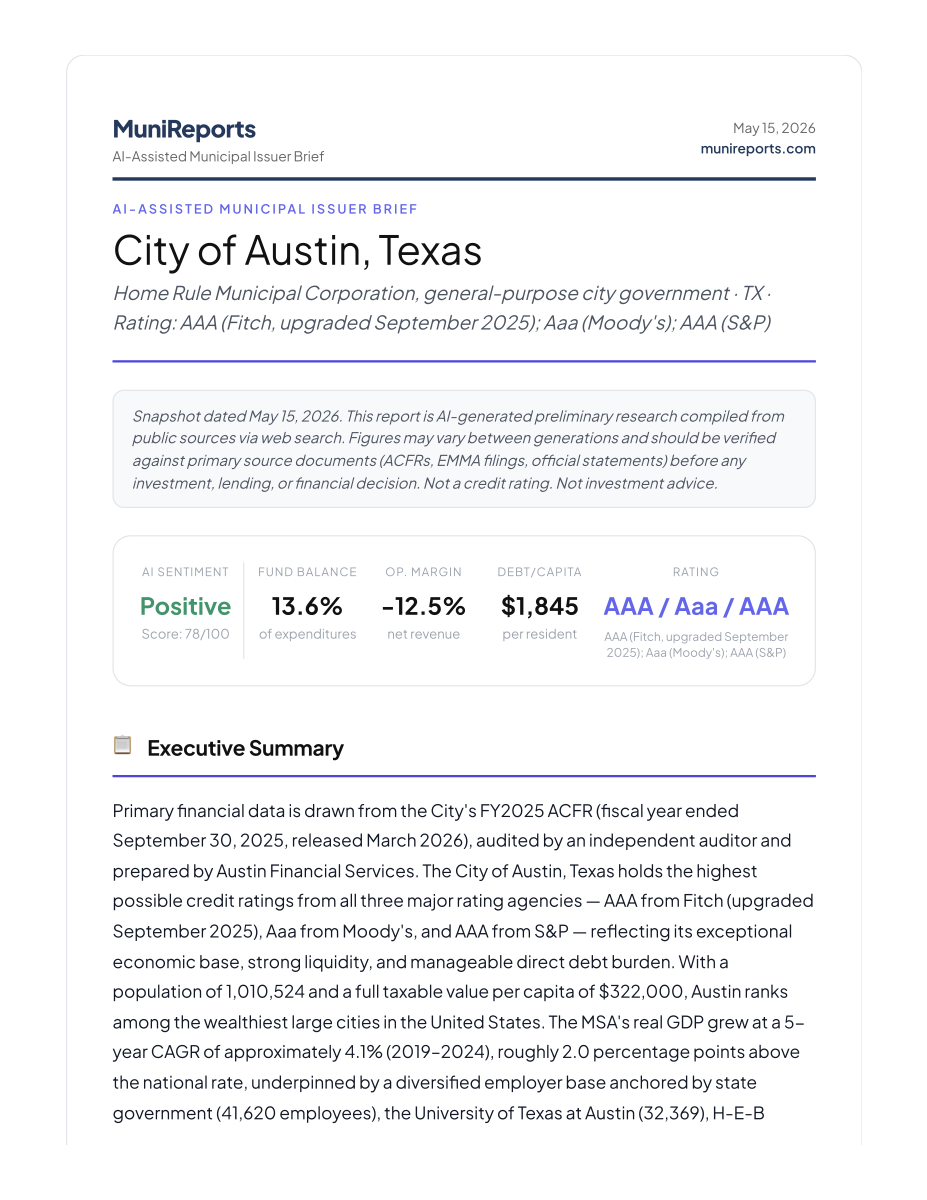
Sample brief — Austin, TX
A 16-page credit research brief covering financials, pension obligations, the Moody's US Cities & Counties scorecard, capital plan, forward outlook, and bond market context. Free to download.
Download PDFCity of Austin, Texas — May 2026
A snapshot of one of the nation's strongest credits — triple-AAA across all three agencies, $325 billion in appraised value, and a meaningful structural fiscal challenge ahead. Covers the FY2025 ACFR, the FY2026 property tax rate increase, the three pension plans, the $4.4 billion FY26–30 capital improvement program, and the bond market context for the City's Series 2025 issuances.
Download Austin brief — PDFGeneral Fund shortfall projected to widen from $33M (FY2026) to $77.9M (FY2030).
Even after $20M in identified operating savings. Sales tax collections projected to decline 1.0% vs. FY2025; Hotel Occupancy Tax revenue forecast 1.5% below budget. Texas SB2's 3.5% annual revenue growth cap limits the repeatability of large rate increases.
Source: City of Austin FY2026–FY2030 Financial Forecast (April 2025)
See full forward outlook in the Austin brief →Aaa.
The scorecard-indicated outcome is computed by applying Moody's published methodology to Austin's public financial data. Eight sub-factors, weighted, mapped to buckets — every input shown.
MuniReports is not affiliated with Moody's. Scorecard-Indicated Outcome is the result of applying the published methodology to public source data and is not a Moody's rating.
We sit at the intersection of agency methodology and issuer reality.
Most municipal credit research is built for one audience or the other — academic analyses that ignore the operational pressures issuers actually face, or quick-turn ratings memos that miss how the methodology really works under the hood. We've sat on both sides. Our briefs apply the Moody's published US Cities & Counties scorecard and US K-12 Public School Districts methodology against real ACFR and EMMA data, with every figure sourced and every scorecard sub-factor showing its inputs. They're decision-quality research, not summaries.
For issuer finance teams preparing for a rating cycle, we bring the same analytical rigor to the table — anticipating the questions analysts will ask, surfacing the weaknesses before agencies do, and shaping the credit narrative around what actually moves a rating. Practical preparation, drawn from years inside both a rating agency and a major government banking practice.
Get in touch.
Tell us what you need — a single brief, a rating-cycle engagement, or a quick scoping call. We respond within one business day.
Email admin@munireports.com